

Local Citations: What They Are and Which Ones Matter
What local citations are, why consistent business details matter for local rankings and AI answers, and which listings to fix first.
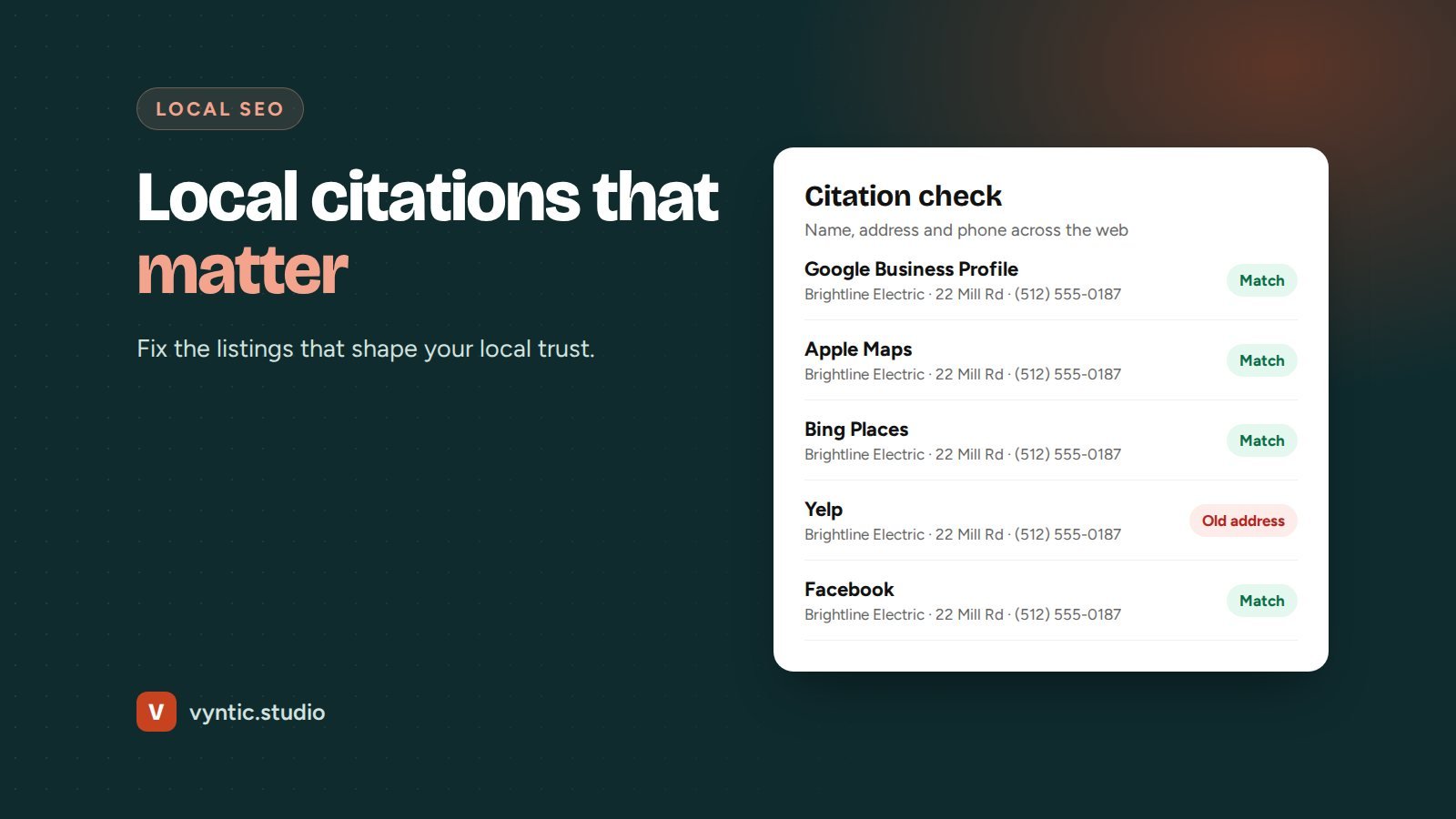
Local citations are online mentions of your business name, address and phone number, often called NAP. They appear on map apps, review sites, social profiles, industry directories and local websites. When they are accurate and consistent, they support your local rankings and help customers find you. When they disagree, they confuse people, search engines and AI tools.
This guide explains how local citations work today, which ones matter most and how to clean up the ones that are wrong.
Why local citations still matter
Citations matter less for rankings than they did ten years ago, but they still play three important roles:
- Trust: consistent details across trusted sites help Google confirm that your business is real and where it is.
- Discovery: many customers find businesses on Apple Maps, Yelp, Facebook or industry directories, not just Google.
- AI answers: AI tools often cite directories and review sites when they describe local businesses. Wrong details there can end up in their answers.
The biggest risk is not missing citations. It is wrong ones: an old address, a closed phone number or a former business name that keeps sending customers to the wrong place.
The local citations to fix first
The core platforms
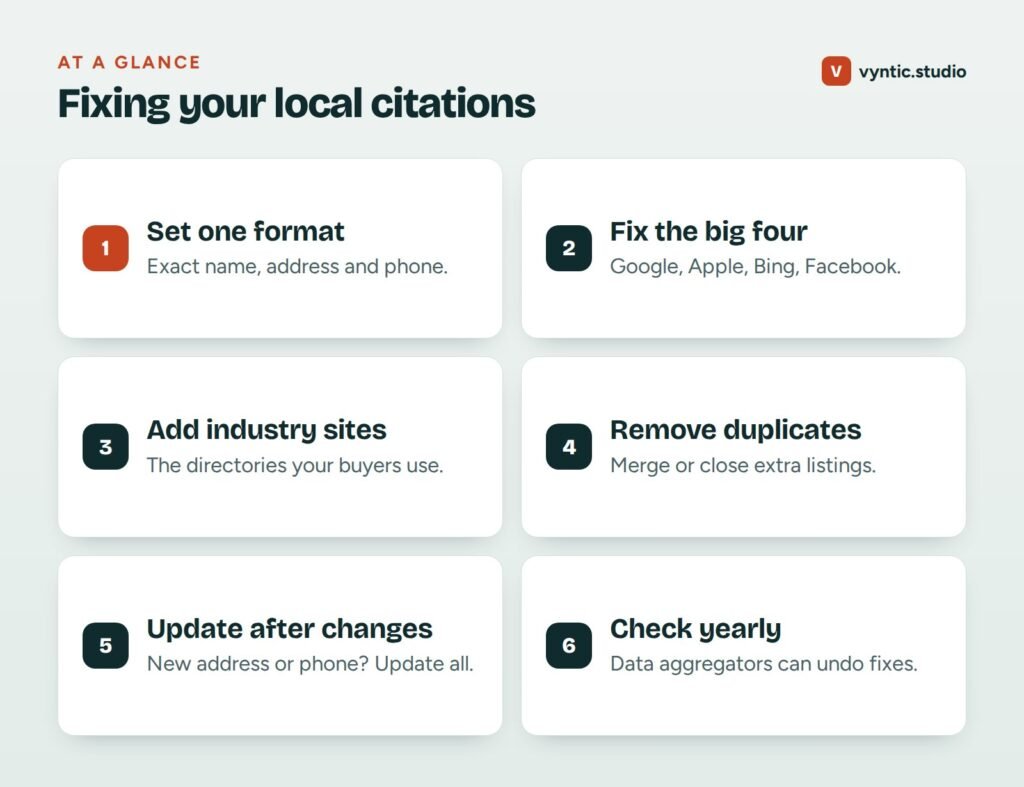
Start with the listings that most people and systems rely on:
- Google Business Profile
- Apple Business Connect (Apple Maps)
- Bing Places for Business
- Facebook business page
- Yelp
Industry directories
Next, the directories your customers use in your field. For example, Healthgrades and Zocdoc for medical practices, Avvo and Justia for lawyers, Houzz and Angi for home services, and TripAdvisor for hospitality. These often rank well in Google themselves and are frequently cited by AI tools.
Local sources
Finally, local business associations, chambers of commerce, local news sites and community directories. These are also good sources of local links.
How to clean up your local citations
Step 1: Choose one exact format
Write down your business name, address and phone number exactly as they should appear everywhere. Decide on details such as “Street” or “St”, suite numbers and phone format. Use the same format on your website footer and Google Business Profile.
Step 2: Find what is out there
Search Google for your business name, your phone number and any old addresses or phone numbers you have used. Note every listing with wrong or old details. Free scan tools from listing providers can speed this up.
Step 3: Fix the most important ones first
Claim and correct the core platforms and your main industry directories. Most let you claim the listing by verifying with a phone call, email or code.
Step 4: Remove or merge duplicates
Duplicate listings split your reviews and confuse search engines. Most platforms let you report or merge duplicates once you have claimed the main listing.
Step 5: Watch the data aggregators
In some countries, data aggregators supply business details to many smaller sites. If an aggregator has your old address, fixes on smaller sites can be overwritten. In the US, check the main aggregators such as Data Axle and Foursquare.
How local citations affect AI answers
When ChatGPT, Perplexity or Google AI Overviews describe a local business, they often pull details from directories and review sites. If Yelp still lists your old address or a directory shows a phone number you stopped using two years ago, that wrong detail can end up in an AI answer. Cleaning up your local citations is one of the simplest ways to make AI tools describe your business accurately. Check the sources AI tools cite for your type of business, and make those listings a priority.
Local citations after a move or rebrand
Moving premises, changing phone numbers or rebranding are the moments when citations cause the most damage. Make a list of every listing before the change, update the core platforms on the day, then work through the rest within a few weeks. Keep the old phone number forwarding for as long as possible.
Common mistakes
- Using a tracking phone number on some listings and your main number on others. If you use call tracking, set it up so your main number stays consistent.
- Adding keywords to your business name on directories.
- Creating new listings instead of claiming existing ones, which leads to duplicates.
- Paying for hundreds of low quality directory listings that nobody visits.
Where citations fit in local SEO
Citations are one part of a strong local presence, alongside your profile, website and reviews. Our local SEO checklist shows where they fit, and our guide to local business SEO covers the full picture. Consistent details also improve your AI search visibility.
Our local SEO services include a full citation audit and cleanup. Book a free project call and we will check your main listings with you.
Frequently asked questions
What is a local citation?
A local citation is any online mention of your business name, address and phone number, such as a listing on Google, Apple Maps, Yelp, Facebook or an industry directory.
Do local citations still matter for SEO?
Yes, though less than in the past. Consistent citations on important sites support trust in your business details. Wrong or conflicting citations can confuse customers, Google and AI tools.
How many local citations do I need?
Quality beats quantity. Accurate listings on the main platforms and the key directories in your industry and area matter far more than hundreds of low quality listings.
Should I pay for a citation building service?
For a single location, you can usually fix the important listings yourself in a few hours. Paid tools help businesses with many locations or a messy history of addresses and phone numbers.
Comments