
How to get recommended by ChatGPT
How AI tools pick which businesses to recommend, and six practical steps to become one of them.
More people now ask AI tools for recommendations instead of scrolling through search results. If you want to get recommended by ChatGPT, Perplexity or Google AI, you need to understand how these tools choose which businesses to mention. The good news is that most of it comes down to clear information and a trusted reputation.
How AI tools decide who to recommend
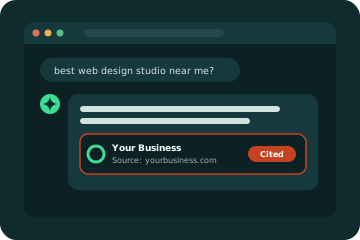
AI assistants build their answers from sources they can read and trust. That includes your website, review sites, directories, news articles, forums and other pages that mention you. When someone asks for the best accountant in Manchester, the tool looks for businesses that clearly match the request and that other sources speak well of.
That means two things matter most: how clearly your own website explains what you do, and how often you appear, positively, on other trusted sites.
Step 1: State the facts clearly
AI tools struggle with vague marketing language. Your website should say, in plain words, what you do, who you do it for, where you work and roughly what it costs. Put these facts on your homepage, service pages and about page. A sentence like we are a family dental clinic in Leeds offering check-ups, implants and Invisalign is far more useful than delivering excellence in oral care.
Step 2: Answer real questions
People ask AI tools full questions, so pages that answer questions directly are more likely to be quoted. Add FAQ sections to your service pages, write short guides that answer common customer questions and keep answers concise and specific. Each answer should make sense on its own, even if someone only reads that paragraph.
Step 3: Add structured data
Schema markup describes your business in a format machines can read: your name, services, locations, opening hours, reviews and more. It removes guesswork for both Google and AI tools. Most SEO plugins support it, and our AI search visibility service sets it up in detail.
Step 4: Make sure AI crawlers can read your site
Some websites accidentally block AI crawlers, or hide content behind scripts they cannot read. Check your robots.txt file, keep important content in plain HTML and make sure your site loads quickly. Some businesses also add an llms.txt file, a simple summary of the site written for AI tools.
Step 5: Build your reputation elsewhere
This is the part most businesses miss. AI tools lean heavily on what other sites say about you. Strengthen your Google Business Profile, collect reviews on the platforms your industry uses, get listed in relevant directories and look for chances to be mentioned in local news or industry articles.
- Keep your Google Business Profile complete and active
- Collect reviews on Google and one or two industry sites
- Get listed in respected directories for your field
- Share expertise in articles, podcasts or local media
Step 6: Check what AI tools say about you
Ask ChatGPT, Perplexity and Google the questions your customers ask, and note who gets mentioned. Repeat the same questions every month. It is the simplest way to see whether your work is paying off.
Can anyone guarantee it?
No. Nobody controls what AI tools say, and anyone promising guaranteed recommendations is overselling. What you can do is make your business far easier to understand and trust. Over time, that raises your chances of being named.
Where to start
A simple example
Imagine two physiotherapy clinics in the same town. The first has a homepage that says we help you feel your best. The second says we are a physiotherapy clinic in Bristol treating back pain, sports injuries and post-surgery recovery, with same-week appointments. The second clinic also has forty Google reviews and a listing on a respected health directory. When someone asks an AI tool for a physio in Bristol for a sports injury, the second clinic is far easier to recommend.
Nothing about that example is complicated. It is clear information plus visible trust. That is the heart of getting recommended by ChatGPT and other AI tools.
Mistakes to avoid
- Hiding prices, locations or services behind vague wording
- Publishing thin pages stuffed with keywords
- Ignoring reviews on the platforms your customers use
- Blocking AI crawlers by accident in robots.txt
- Changing your business name or details across different sites
What AI tools read about your business
AI assistants build their answers from what they can find and trust. That usually means your own website, your Google Business Profile, review sites, industry directories, news mentions and forum discussions. If these sources agree on what you do, where you work and how good you are, an AI tool has a clear, confident picture to share. If they disagree or say very little, the tool is more likely to recommend someone else.
This is why the basics of local SEO matter so much. A complete profile, steady reviews and consistent details everywhere are exactly the signals AI tools pick up. Our Google Business Profile guide walks through the profile side step by step.
Write pages that answer, not just describe
Most service pages describe a business: we are friendly, we are experienced, we offer great value. AI tools find it hard to use that. They do much better with pages that answer questions directly: what a service costs, how long it takes, who it is for, what is included and how you compare with alternatives. Clear answers are easy to quote, and pages that get quoted are the ones that get recommended.
- Put a short, direct answer at the top of each page, then the detail
- Use real numbers where you can, such as price ranges and timelines
- Add an FAQ section built from questions customers actually ask you
- Name the areas you serve and the types of clients you work with
Our articles on website costs and SEO costs are examples of this style: each one answers a common question plainly before going into detail.
Keep your technical foundations clean
A fast, well structured site is easier for every crawler to read, including the ones used by AI companies. Pages that load slowly, hide text inside images or depend on heavy scripts can be skipped or misunderstood. If your site struggles here, our website speed optimization work and a check of your Core Web Vitals are good first steps. Google also explains how its AI features use website content in its guide to AI features and your website.
How long it takes
There is no instant switch. Changes to your website can be picked up within weeks, but reputation signals such as reviews and mentions build over months. Most businesses that work on this steadily see AI tools describe them more accurately within three to six months, and start appearing in recommendations as their reviews and mentions grow.
If you only do one thing this week, rewrite your homepage and main service page so they state the facts clearly. Then work through the rest of the list. If you would like help, our AI search visibility service covers every step, and good SEO makes all of it work better. You can also start with a free website audit.
Want help with this? Our AI search optimization services cover crawlability, structured data, consistent business facts and answer-style content, with tracking of AI mentions over time.
Frequently asked questions
Does ChatGPT use Google results?
AI tools use a mix of their training data and live web sources, depending on the tool and setting. Strong SEO helps with both.
What is llms.txt?
A simple text file that summarises your site for AI tools. It is optional and still new, but easy to add.
How long does it take?
Most businesses see their first AI mentions within a few months of clarifying their information and building reviews.
Can I pay to be recommended by ChatGPT?
No. There is no paid placement in ChatGPT's organic answers. Recommendations come from what the model finds and trusts about your business.
Does ChatGPT read my website?
When it searches the web, yes. It can visit pages to answer a question, which is why clear, crawlable pages matter.
Do reviews affect AI recommendations?
Yes. AI tools often mention businesses with strong, recent reviews on Google and other trusted platforms.
Should I block AI crawlers?
Blocking them can stop your content being used, but it can also reduce how often you are mentioned. Most businesses benefit from allowing them.
Does schema markup help with AI search?
It helps tools understand facts such as your name, location, services and opening hours, which reduces mistakes in answers.
How do I check what AI tools say about me?
Ask ChatGPT, Gemini, Copilot and Perplexity the questions your customers would ask, note the answers and repeat every month.
Is AI search visibility different from SEO?
It builds on SEO. Most of the work overlaps, with extra focus on clear facts, direct answers and your reputation across the web.
Key takeaways
The businesses that do well here are rarely the ones with the biggest budgets. They are the ones that get the basics right, measure what changes and keep going month after month. If you would like a second pair of eyes on your own site, get a free website audit or talk to us.