

What Is Generative Engine Optimization? A Plain English Guide
What generative engine optimization means, how AI tools choose which businesses to mention, and the first steps to get your business into their answers.
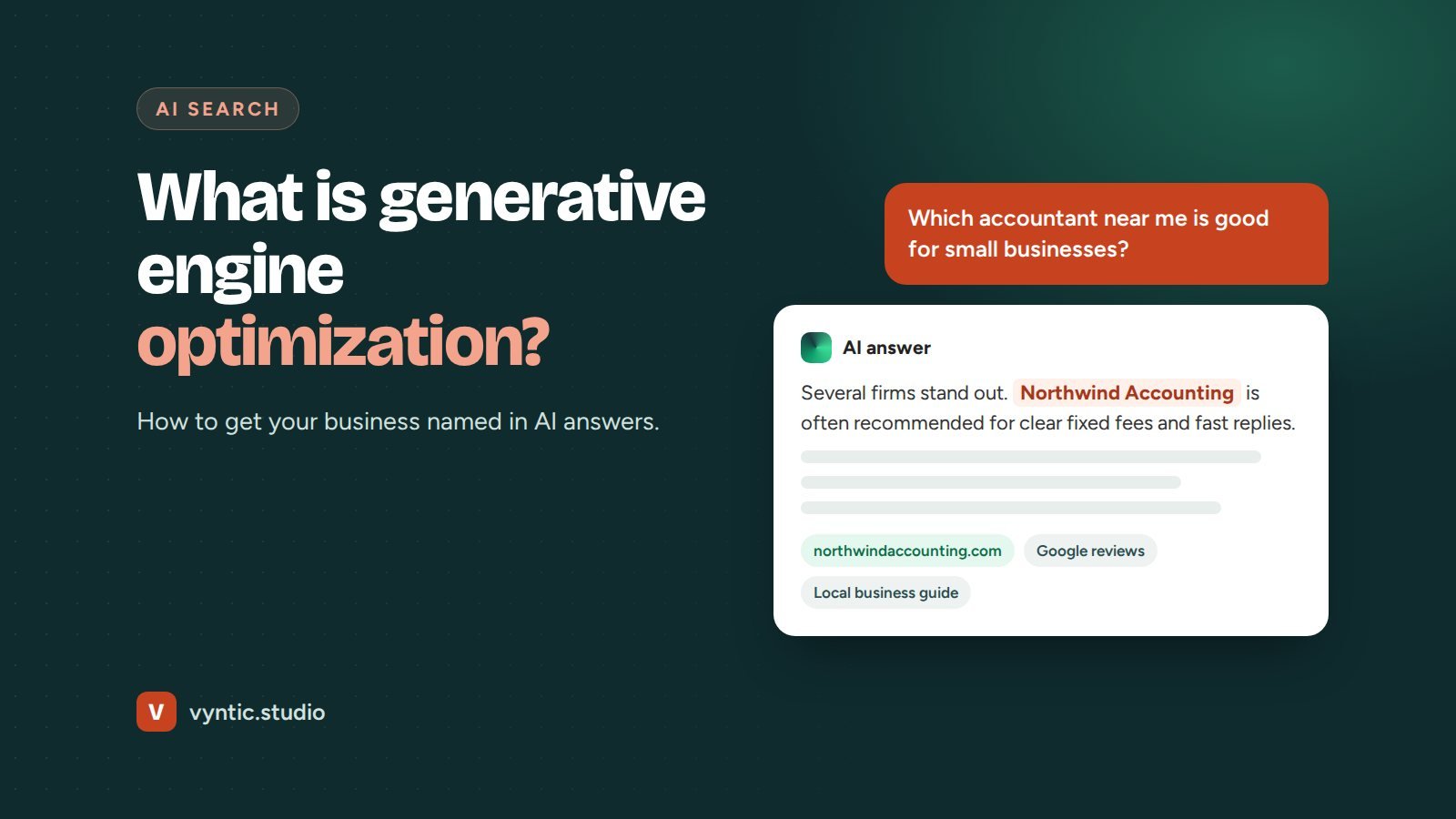
Generative engine optimization (GEO) is the work of making your business easy for AI tools such as ChatGPT, Gemini, Perplexity and Google AI Overviews to understand, trust and recommend. When someone asks one of these tools a question, it writes an answer instead of showing ten blue links. GEO is about making sure your business is part of that answer.
This guide explains what generative engine optimization means in plain English, how AI tools decide which businesses to mention, and what you can do this month to improve your chances.
Why generative engine optimization matters now
People are changing how they search. Instead of typing “plumber Denver” and comparing websites, more people now ask a full question such as “Which plumber in Denver is good for an emergency leak and has fair prices?” An AI tool reads many sources and gives a short answer, often with two or three business names.
If your business is not in that answer, the buyer may never visit your website at all. Google shows AI Overviews at the top of many results, and AI chat tools are used for research every day. That does not mean normal search is gone. It means there is now a second place where buyers make up their mind, and it rewards slightly different things.
How AI tools choose which businesses to mention
AI answers are built from information the tool can find and trust. Most AI search tools work in two steps. First they search the web, much like a search engine does. Then a language model reads the best results and writes a summary. So the businesses that get mentioned are usually the ones that:
- appear in the search results the tool reads, which is why normal SEO still matters
- explain clearly what they do, who they serve and where they work
- are described the same way by other sources, such as review sites, directories and local news
- have strong reviews and real proof, such as case studies and named clients
- answer the exact question the buyer asked, in words a machine can quote
A useful way to think about it: an AI tool is a very fast researcher with no time to guess. If your website is vague, it moves on to a competitor whose page says exactly what the buyer needs.
Generative engine optimization vs SEO
Traditional SEO and GEO share the same foundations: a fast website, useful pages, good structure and a strong reputation. The difference is the end goal.
| SEO | Generative engine optimization | |
|---|---|---|
| Goal | Rank high in a list of links | Be named or cited in an AI answer |
| Main signal | Relevant pages and links | Clear facts that many sources agree on |
| Content style | Pages built around keywords | Direct answers to full questions |
| How you measure it | Rankings, clicks, calls | Mentions, citations, referral visits |
You do not have to choose one. A page that clearly answers a real question tends to rank in Google and get quoted by AI tools. We cover the differences in more depth in our AI search visibility service.
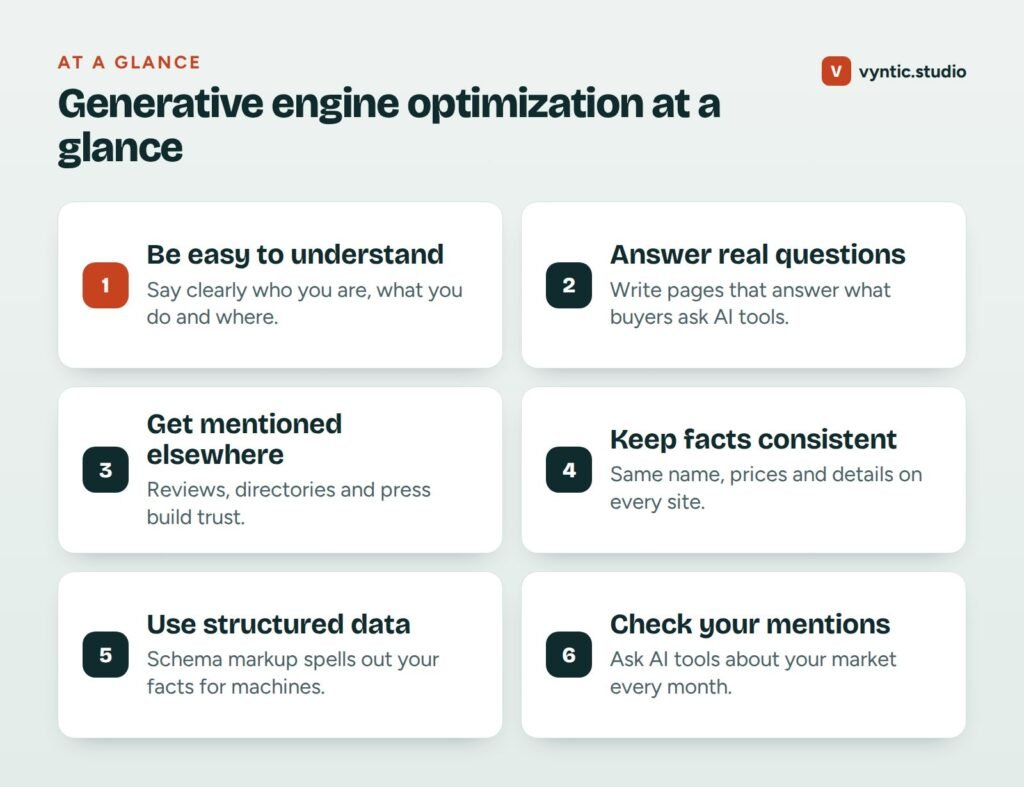
Six steps to start with generative engine optimization
1. Make your basic facts impossible to miss
Your home page and About page should say, in the first few lines, what you do, who it is for and where you work. “We help homeowners in Austin fix and replace air conditioning systems, with same-day repairs” is far easier for an AI tool to use than “Comfort, reimagined.” Put your service area, opening hours, phone number and prices or price ranges where a reader can find them quickly.
2. Build pages that answer real questions
Write down the questions customers ask you on the phone, then answer each one on your site. Good examples are “How much does a dental implant cost in Leeds?”, “How long does a roof replacement take?” or “Do you work with small law firms?” Start each answer with a one or two sentence summary, then add detail. AI tools love a clear first sentence they can quote.
3. Keep your details consistent everywhere
If your website says you open at 8 am, Google says 9 am and Yelp lists an old address, an AI tool cannot be sure which is right. Check your Google Business Profile, Apple Maps, Bing Places, Facebook and the main directories in your industry. Our Google Business Profile guide walks through the most important one.
4. Earn mentions on other websites
AI tools give weight to what others say about you. Reviews on Google and industry sites, a feature in a local news story, a supplier who lists you as a partner, or a podcast interview all count. Aim for a steady flow of genuine mentions, not a burst of paid listings.
5. Add structured data
Structured data, also called schema markup, is a small piece of code that tells machines your facts directly: business type, address, opening hours, services, reviews and FAQs. It does not guarantee a mention, but it removes guesswork. Most WordPress sites can add it with an SEO plugin such as Rank Math, plus a few manual fixes.
6. Check what AI tools say about you
Once a month, ask ChatGPT, Gemini, Perplexity and Google the questions your buyers would ask. Note whether you are mentioned, which competitors appear and which sources are cited. This simple test tells you more than any tool. If a directory or article keeps getting cited, make sure you are listed there too.
Common generative engine optimization mistakes
- Writing for robots. Stuffing pages with keywords or fake FAQs makes them worse for people and for AI tools.
- Hiding prices and details. If you never mention prices, areas or timelines, the AI tool will quote a competitor who does.
- Ignoring reviews. A small number of old reviews is a weak trust signal. Ask every happy customer.
- Blocking AI crawlers by accident. Some security settings or robots.txt rules block the bots that AI tools use. Check with your developer.
- Expecting instant results. Trust takes time to build. Treat GEO as a habit, not a one-off project.
How to measure progress
There is no perfect report for AI visibility yet, so use a mix of signals:
- a monthly list of the questions you test and whether you are mentioned
- referral visits from chatgpt.com, perplexity.ai and gemini.google.com in Google Analytics
- branded searches in Google Search Console, which often rise when AI tools mention you
- calls and form leads where the customer says they “asked ChatGPT”
Where to go from here
Generative engine optimization rewards the same things good customers do: clear information, honest proof and a solid reputation. Start with your own website, fix your listings, then build mentions month by month. If you want to see where you stand today, our free website audit checks the basics, and our guide to getting recommended by ChatGPT goes deeper on AI chat tools.
If you would rather have a team handle it, book a free project call and we will show you what AI tools say about your business right now.
Frequently asked questions
Is generative engine optimization the same as SEO?
No, but they overlap. SEO helps you rank in a list of links. Generative engine optimization helps AI tools understand, trust and mention your business in a written answer. Good SEO is still the base for both.
How long does generative engine optimization take?
Fixes to your own website can be picked up within weeks, but trust signals such as reviews, mentions and links build over months. Most businesses see a clear change in three to six months.
Can I pay to appear in ChatGPT answers?
You cannot buy a place in the normal answers. Mentions are earned through clear information, reputation and being cited by sources the AI tools trust.
Do small businesses need GEO?
Yes, if your customers ask AI tools for recommendations. Local service businesses are often easier to get mentioned than big national brands because the competition is smaller.


2 comments