

AI Search Visibility: How to Get Your Business Into AI Answers
How AI tools pick the businesses they mention, how to check your AI search visibility today, and a practical plan to improve it.
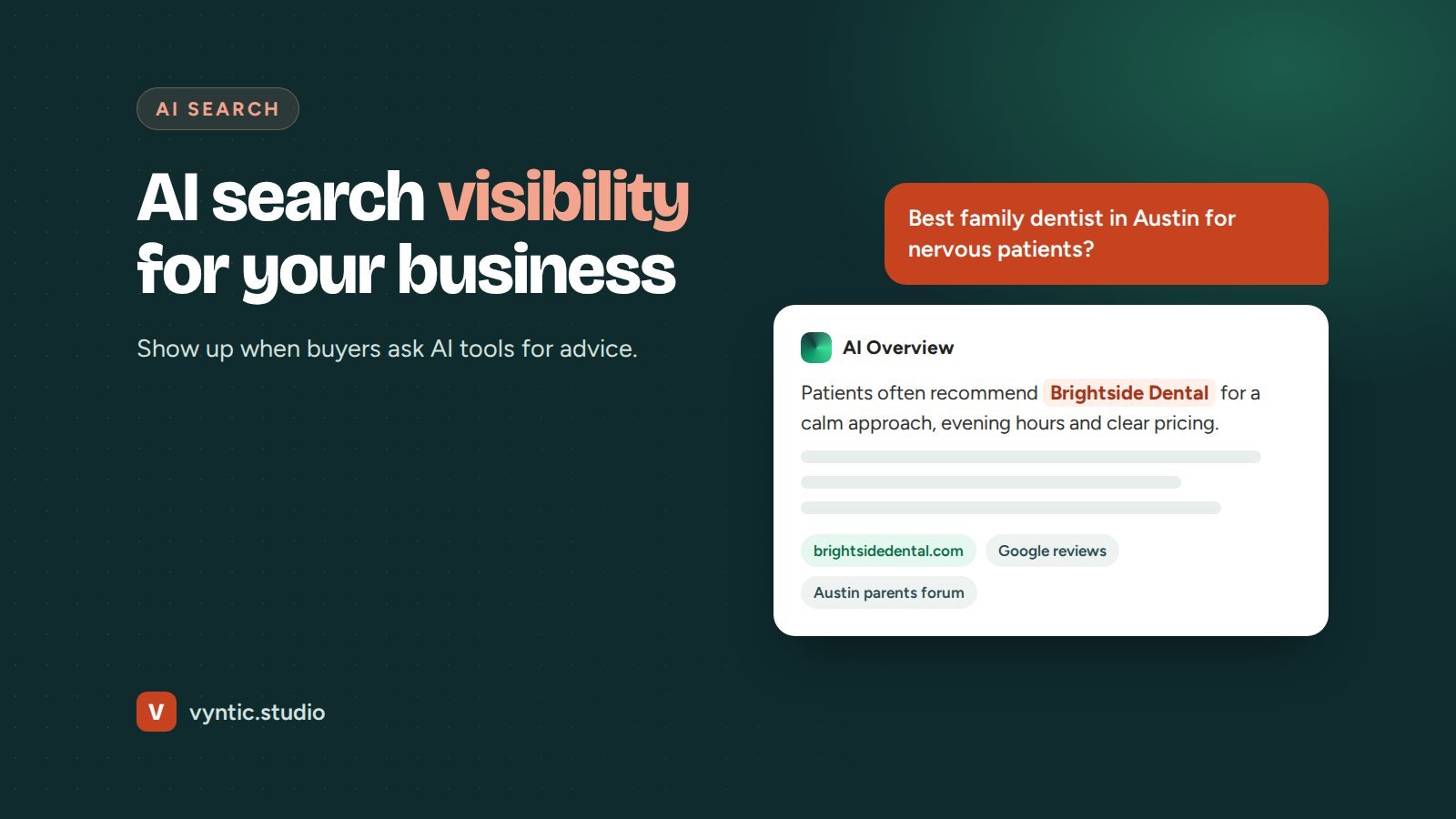
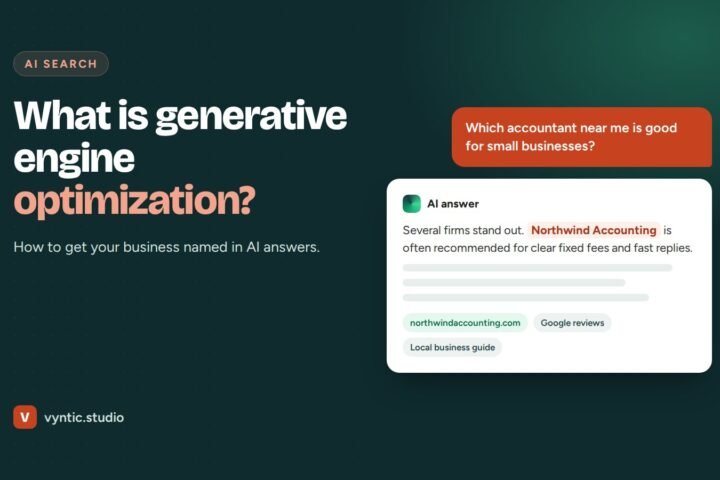
AI search visibility is how often your business shows up when people ask AI tools for help. A homeowner asks ChatGPT for “a reliable roofer near me who does free inspections”. A patient asks Google about “the best dentist in Austin for nervous patients” and reads the AI Overview at the top. A marketing manager asks Perplexity which agencies handle local SEO. In each case the tool writes an answer and names a few businesses. Being one of those names is what AI search visibility is about.
Why AI search visibility is worth your time
AI answers sit at the very top of the journey. Buyers use them to build a shortlist before they ever visit a website. If you are not on that shortlist, your website, ads and reviews may never get a chance to persuade them.
The good news for small businesses: AI tools do not only favor big brands. For local and specialist questions, they often mention the business with the clearest, most consistent information and the strongest local reputation. That can be you.
How AI tools build their answers
Most AI search tools follow a similar pattern:
- They turn the question into one or more web searches.
- They read the top results, including websites, review sites, directories and forums.
- They write a summary and, in many tools, show the sources they used.
So your AI search visibility depends on two things: whether your information appears in the sources the tool reads, and whether that information is clear enough to quote. If you want the full background, start with our guide to generative engine optimization.
Step 1: Check your AI search visibility today
Write down ten questions a real buyer would ask. Mix broad and specific ones:
- “Best [service] in [city]”
- “Who offers [specific service] near [area] with [requirement]?”
- “How much does [service] cost in [city]?”
- “Is [your business name] any good?”
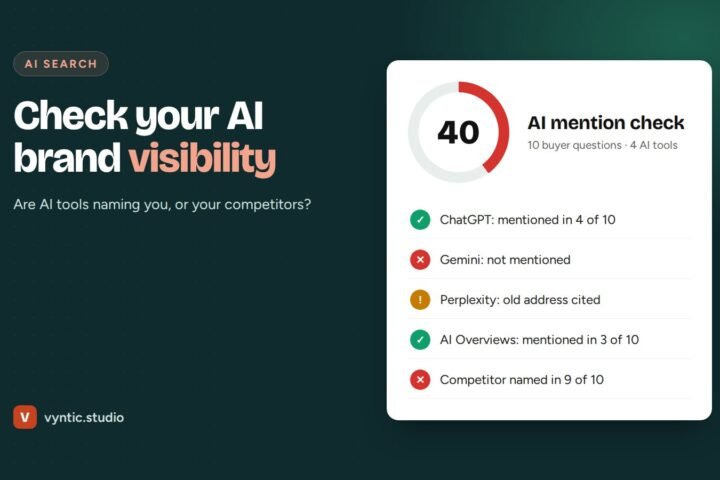
Ask each question in ChatGPT, Gemini, Perplexity, Copilot and Google. Record whether you are mentioned, how you are described, which competitors appear and which sources are cited. Repeat this every month with the same questions so you can compare.
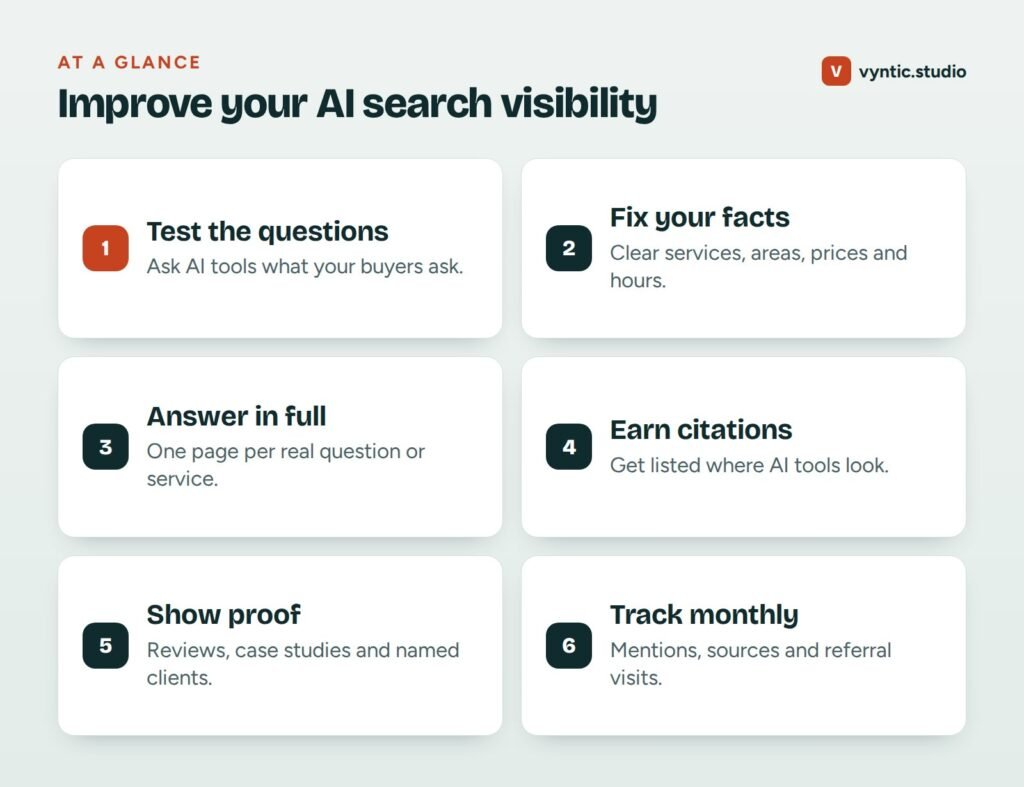
Step 2: Fix the facts on your own website
AI tools quote what is easy to find. Make sure your site states clearly:
- what you do and what you do not do
- who you serve, including industries or customer types
- where you work, with towns and areas named in plain text
- prices or price ranges, timelines and guarantees
- opening hours, contact details and how to book
Put the most important facts in the first lines of each page and in short, quotable sentences. “We repair and replace residential roofs across Leeds and Bradford, with free inspections within 48 hours” is far more useful to an AI tool than a page of slogans.
Step 3: Create pages that answer real questions
AI tools often answer specific questions. If your site has a page that directly answers “How long does a dental implant take?” or “Can a roof be replaced in winter?”, there is a good chance it gets read and cited. Build a page or a section for each important service, and add a short FAQ to each one with honest, specific answers.
Step 4: Be present where AI tools look
When you test your questions, note the sources AI tools cite. They are often:
- Google Business Profile and other map listings
- review sites such as Yelp, Trustpilot or industry-specific platforms
- “best of” lists from local media or associations
- Reddit threads and community forums
- industry directories and partner listings
Make sure you are listed on the relevant ones with consistent details. Where a list or article keeps getting cited, it may be worth asking to be included, as long as you genuinely fit.
Step 5: Strengthen your reputation signals
Reviews, case studies with real numbers, named clients, awards and press mentions all make it easier for an AI tool to describe you with confidence. Ask for reviews that mention the specific service, such as “they replaced our boiler in one day”, because those details often show up in AI summaries.
Step 6: Help machines read your site
Technical basics still matter:
- allow the main AI and search crawlers in your robots.txt unless you have a reason to block them
- add structured data for your business, services, reviews and FAQs
- keep pages fast and readable without relying on heavy scripts
- keep one clear page per topic instead of many thin, similar pages
Mistakes that hurt AI search visibility
- Vague home pages full of slogans instead of facts.
- Different prices, hours or addresses on different sites.
- Blocking AI crawlers in robots.txt or a firewall without meaning to.
- Hundreds of thin pages written quickly, which dilute your expertise.
- Ignoring negative reviews instead of replying calmly and fixing the cause.
How long it takes
Fixes to your own site can show up in AI answers within weeks, especially in tools that search the web live. Reputation and third-party mentions take months. Treat AI search visibility like local SEO: steady monthly work beats one big push.
Get help with AI search visibility
Our AI search visibility service tests the questions your buyers ask, fixes your site and listings, and builds the mentions that AI tools rely on. For ChatGPT specifically, read our guide on how to get recommended by ChatGPT. Or book a free project call and we will run your first visibility test with you.
Frequently asked questions
What is AI search visibility?
It is how often, and how well, your business appears in answers from AI tools such as ChatGPT, Gemini, Perplexity, Copilot and Google AI Overviews when people ask about your type of service.
Is there a tool that measures AI search visibility?
Several tools now track brand mentions in AI answers, but results vary between runs. A simple monthly manual test with the same questions is still one of the most reliable ways to see progress.
Do AI tools use my Google reviews?
Many AI answers about local businesses draw on review sites and map listings, including Google. Strong, recent reviews help both your local rankings and your AI search visibility.
1 comment