

What Is a Good Website Conversion Rate for a Small Business?
Typical conversion rate ranges for small business websites, how to calculate yours correctly, and the changes that raise it fastest.
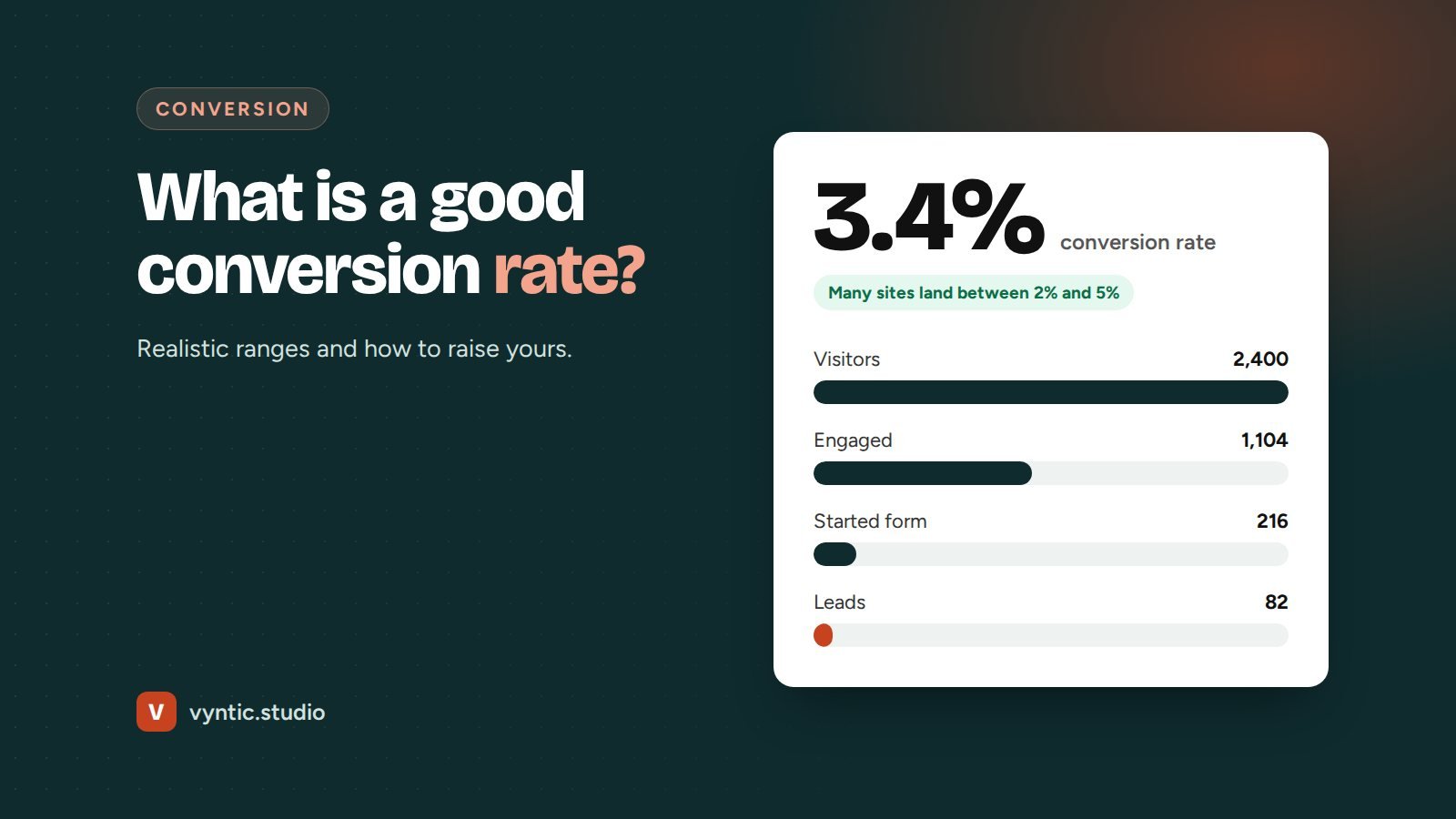
A good website conversion rate for most small business sites sits somewhere between 2 and 5 percent. That means two to five out of every hundred visitors call, fill in a form, book or buy. But that number on its own tells you very little. A plumber with mostly emergency traffic might convert 10 percent, while a design agency with lots of blog visitors might convert 1 percent and still be doing well.
This guide explains what a good website conversion rate looks like for your type of site, how to measure it properly, and the changes that usually raise it fastest.
What counts as a conversion
A conversion is any action that moves a visitor towards becoming a customer. For a small business, the important ones are:
- phone calls from the website
- contact or quote form submissions
- online bookings
- purchases in an online store
- sign-ups for a free audit, consultation or download
Count the actions that lead to revenue. Newsletter sign-ups and time on page are useful signals, but they are not the number to judge your website on.
How to calculate your conversion rate
Conversion rate = conversions ÷ visitors × 100.
If 1,500 people visited your site last month and 45 called or filled in a form, your conversion rate is 45 ÷ 1,500 × 100 = 3 percent.
Two common mistakes make the number look worse than it is: not counting phone calls, and including visitors who were never potential customers, such as job seekers or people reading an old blog post from another country. Look at your service pages separately from your blog.
What is a good website conversion rate by site type
These are rough ranges we see across small business sites. Treat them as a starting point, not a target set in stone.
| Type of site or page | Typical range |
|---|---|
| Emergency or urgent local services | 5% to 15% |
| Local service businesses (dental, legal, trades) | 2% to 6% |
| Ecommerce stores | 1% to 3% |
| B2B services and agencies | 1% to 3% |
| Focused landing pages for paid ads | 5% to 15% |
| Blog and information pages | Under 1% |
Industry studies commonly put average website conversion rates in the 2 to 5 percent range, with big differences by industry and traffic source. The most useful comparison is your own site over time.
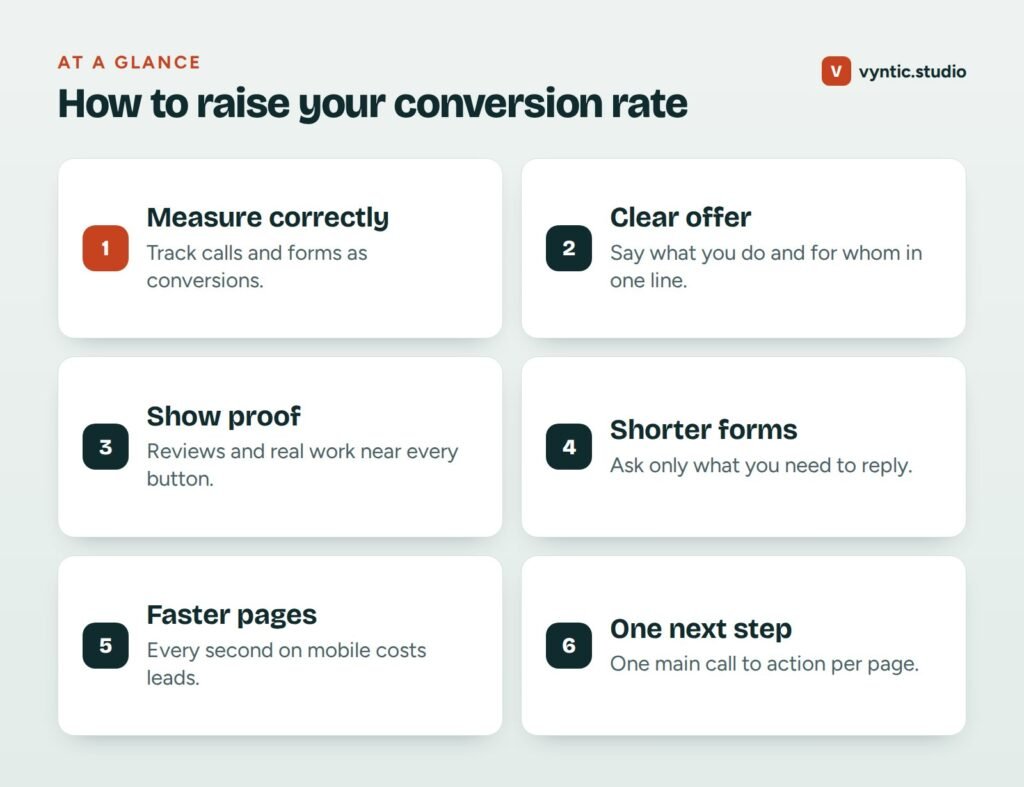
Seven ways to raise your conversion rate
1. Make the offer clear in five seconds
At the top of each page, say what you do, who it is for and why you are the right choice. “Same-day boiler repair in Leeds, fixed prices, 4.9 stars from 300 reviews” converts better than “Welcome to our website”.
2. Put proof next to every call to action
Reviews, star ratings, project photos, client logos and short case studies reduce doubt at the moment someone decides. Place them near your buttons and forms, not on a separate page nobody visits.
3. Shorten your forms
Every extra field costs leads. Ask for name, contact details and one question about the job. Get the rest on the phone.
4. Make calling easy on mobile
Put a tap-to-call button in the header on mobile. Many local customers prefer to call, especially for urgent jobs.
5. Speed up your pages
Slow mobile pages lose visitors before they see your offer. Compress images, remove unused plugins and scripts, and use good hosting.
6. Give every page one main next step
A page with five different buttons confuses people. Choose one primary action per page, such as “Get a quote”, and repeat it in the right places.
7. Match the page to the traffic
If an ad or search result promises “emergency electrician”, the visitor should land on a page about emergency electrical work, not your home page.
How to track conversions properly
Accurate numbers start with good tracking. In Google Analytics 4, mark your key events as conversions, such as form submissions, clicks on your phone number, booking confirmations and purchases. If your form sends people to a thank you page, track visits to that page. If not, track the form submission event.
For phone calls, use a call tracking service that shows a tracking number on your website, or at least track taps on your phone number. Ask new customers how they found you and note it in your CRM or a simple spreadsheet. Compare the numbers each month, and look at conversion rate by page and by traffic source rather than one figure for the whole site. A blog post with a 0.5 percent rate and a service page with a 6 percent rate tell very different stories.
What to do when your rate is low
If your conversion rate is under 1 percent on service pages, start with a website audit to find broken forms, hidden contact details and slow pages. If the site is fundamentally dated, our guide to the signs you need a website redesign will help you decide what to do.
For campaigns, a dedicated page often outperforms the main site. Our landing page design service builds pages with one clear goal for ads and offers.
Get a clear picture
Our free website audit includes a lead conversion check that shows what is stopping visitors from contacting you. Or book a free project call and we will look at your numbers with you.
Frequently asked questions
What is a good website conversion rate for lead generation?
Many service business sites convert somewhere between 2 and 5 percent of visitors into calls or form leads. Specialist services with high intent traffic can do much better.
Should I count phone calls as conversions?
Yes. For many local businesses calls are the main conversion. Use call tracking or at least track clicks on your phone number, otherwise your conversion rate looks lower than it is.
Does more traffic mean more leads?
Not always. More of the wrong traffic can lower your conversion rate without adding leads. It is often cheaper to convert more of the visitors you already have before paying for more.
Why is my conversion rate so low?
The usual causes are traffic that does not match your service, an unclear offer, missing proof, slow mobile pages, long forms or a hidden phone number.

2 comments