

WooCommerce vs Shopify: Which E-Commerce Platform Actually Wins in 2026?
If you are building an online store in 2026, you will almost certainly end up comparing two platforms: WooCommerce and Shopify. They are the two best-known options, and both can run a successful online business. The real question is which one suits yours.
At Vyntic Studio we build on both, through our WooCommerce development and Shopify development services, so we have no reason to push you toward either one. This WooCommerce vs Shopify comparison looks at the things that matter most: cost, flexibility, SEO, growth and ease of use. By the end you should have a clear idea of which platform fits your goals.
A Quick Overview of Each Platform
WooCommerce
WooCommerce is a free, open-source ecommerce plugin for WordPress. It is one of the most widely used store platforms in the world. Because it runs inside WordPress, you get everything WordPress offers: full ownership of your data, full control over the code and a huge range of plugins and integrations.
Shopify
Shopify is a hosted, all-in-one ecommerce platform. It takes care of hosting, security, updates and infrastructure in return for a monthly subscription. It is designed to get a store online quickly with little technical knowledge, and it is especially popular with direct-to-consumer brands and dropshipping businesses.
Cost Comparison: What You Actually Pay
This is where the comparison gets more interesting than most people expect, because the true cost is not always obvious at the start.
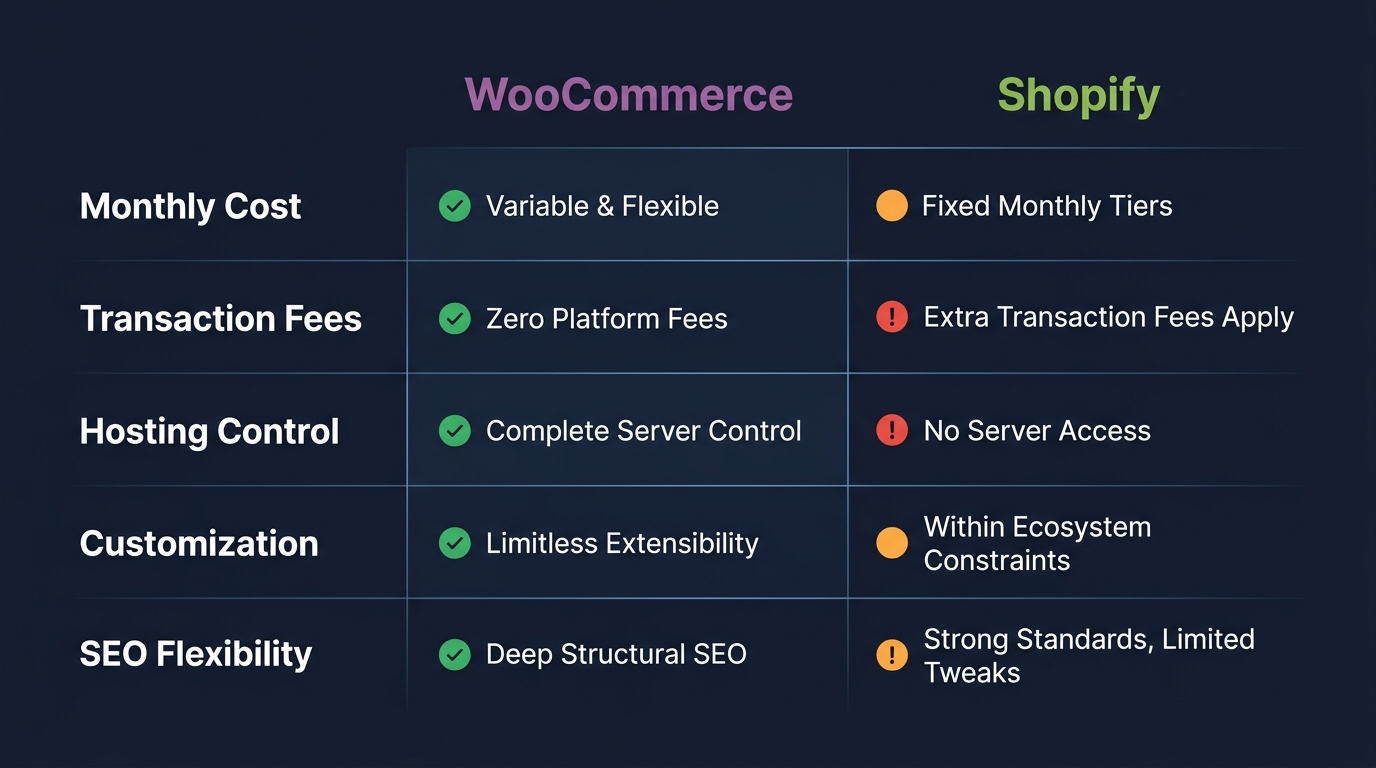
Shopify’s Cost Structure
- Monthly plan: Shopify has several tiers, from a basic plan for new stores up to advanced plans for larger businesses. Check Shopify’s pricing page for current figures in your currency.
- Transaction fees: an extra fee on every sale if you use a payment provider other than Shopify Payments, which is not available in every country
- Apps: many useful features come from paid third-party apps, each with its own monthly fee
For a growing store, the subscription is often the smallest part of the bill. Add up transaction fees and a handful of apps, and the monthly running cost can be a lot higher than the headline price.
WooCommerce’s Cost Structure
- WooCommerce plugin: free
- Hosting: a monthly fee for good managed WordPress hosting, which grows with your store
- Domain: a small yearly fee
- SSL: free through Let’s Encrypt with most hosts
- Transaction fees: none from WooCommerce itself; you pay only your payment provider’s standard fee (Stripe or PayPal, for example)
- Extensions: many are free, and paid ones are often charged yearly rather than monthly
For stores with steady sales, avoiding platform transaction fees and monthly app fees can make WooCommerce cheaper to run over time. The trade-off is that you pay for hosting and maintenance instead, either your own time or a care plan. Our website cost guide explains how to compare total costs fairly.
Flexibility and Customization
WooCommerce clearly wins here. Because it is open source and runs on WordPress, you can change almost anything: the checkout flow, product page layout, cart, admin screens and even the data structure. If you can describe it, a developer can usually build it.
Shopify gives you good design flexibility through its Liquid themes, but you always work inside the limits Shopify sets. Some things cannot be changed on Shopify whatever your budget, such as parts of the URL structure, and checkout customization depends on your plan.
For most standard stores, Shopify’s flexibility is enough. For businesses with complex needs, such as custom pricing rules, B2B portals, unusual checkout logic or deep integrations with other systems, WooCommerce gives you room to build exactly what you need.
SEO Capability
WooCommerce on WordPress gives you more SEO control than most ecommerce platforms. You control URL structures, canonical tags, schema markup, titles and descriptions, headings, internal links and the rest of your technical SEO.
With plugins like Rank Math or Yoast SEO, a WooCommerce store can be tuned in ways that are harder inside Shopify. For example, Shopify adds “/collections/” and “/products/” to URLs and does not let you remove them, which limits your URL structure and needs careful redirect planning during migrations.
Shopify’s SEO has improved a lot over the years, and for many businesses it is perfectly adequate. But if organic search is a main growth channel for you, WooCommerce offers a real advantage. Our SEO services work with both platforms.
Ease of Use
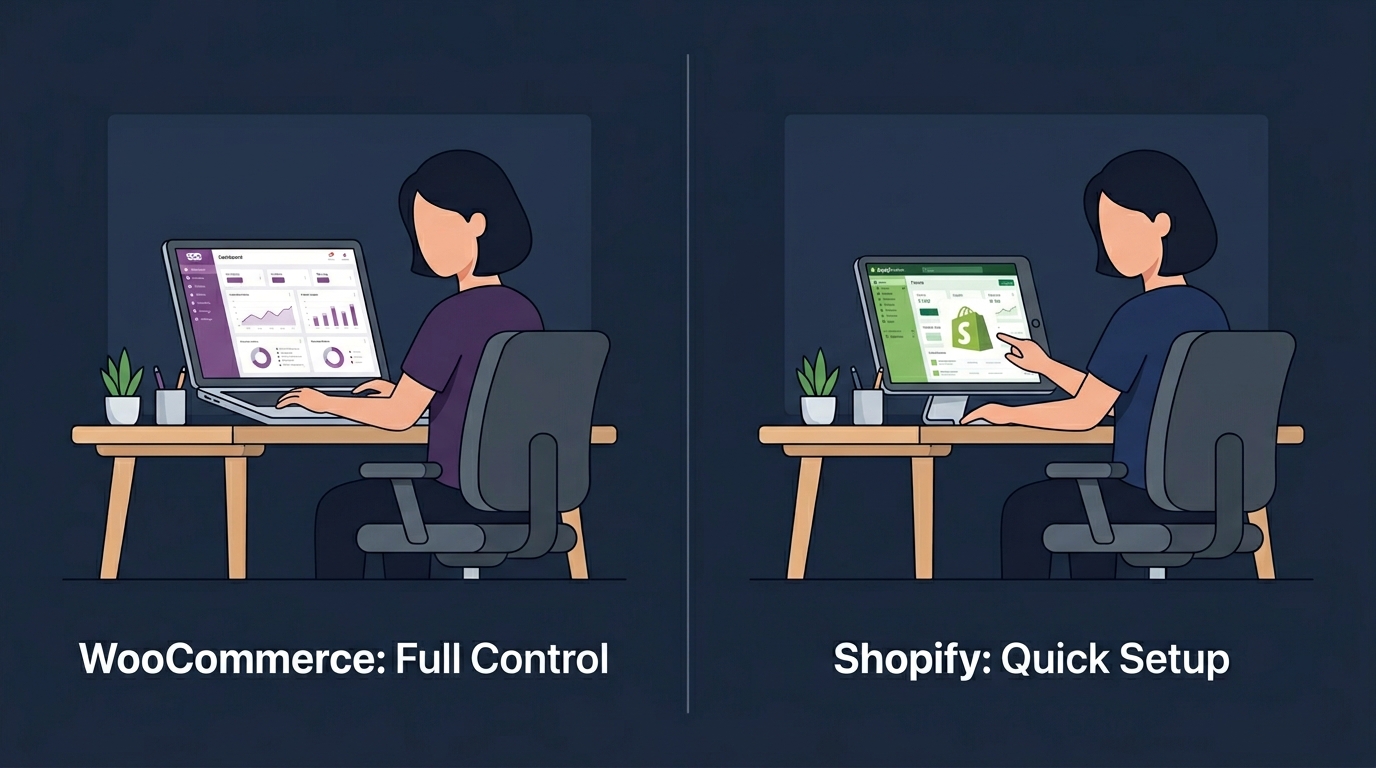
Shopify is easier to use out of the box. The admin is clean and simple, and it guides new store owners through setup. There is no hosting to arrange, no WordPress updates to manage and no infrastructure decisions to make.
WooCommerce takes more learning at the start. You are responsible for hosting, updates, backups and security, either yourself or through a developer or agency. For owners who want full control, that is a benefit. For owners who want to focus only on products and marketing, it can feel like extra work.
That is why many businesses hire an agency for a WooCommerce build: they get the platform’s advantages without carrying the technical work themselves. Our ecommerce development service covers the build and launch, and our care plans cover the upkeep afterwards.
Scalability
Both platforms can grow with you, but in different ways.
Shopify’s infrastructure scales automatically, so you do not need to think about server capacity as traffic and orders grow. That is a real advantage for stores with sudden spikes, such as seasonal peaks or a product going viral.
WooCommerce scales with your hosting. On good managed hosting with proper caching, WooCommerce can handle high traffic and large order volumes, but it needs to be set up deliberately. The same store will struggle on cheap shared hosting and run well on properly configured hosting. Our guide to WordPress architecture for scalability explains what that setup looks like.
Who Should Choose WooCommerce?
WooCommerce is usually the better choice for businesses that:
- Want full ownership of their store, data and code
- Already have, or are building, a WordPress website and want the store in the same place
- Have complex product needs such as variable pricing, subscriptions, B2B or wholesale
- Sell enough that avoiding platform transaction fees makes a real difference
- Care most about SEO and want full control over technical optimization
- Plan to heavily customize checkout or product pages
Who Should Choose Shopify?
Shopify is usually the better choice for businesses that:
- Want to launch quickly with little technical setup
- Prefer a fully managed platform with no hosting or updates to worry about
- Have a simple product catalog without complex pricing or checkout needs
- Run a dropshipping business that relies on Shopify’s app ecosystem
- Expect large traffic spikes and want scaling handled for them
Thinking About Switching from Shopify to WooCommerce?
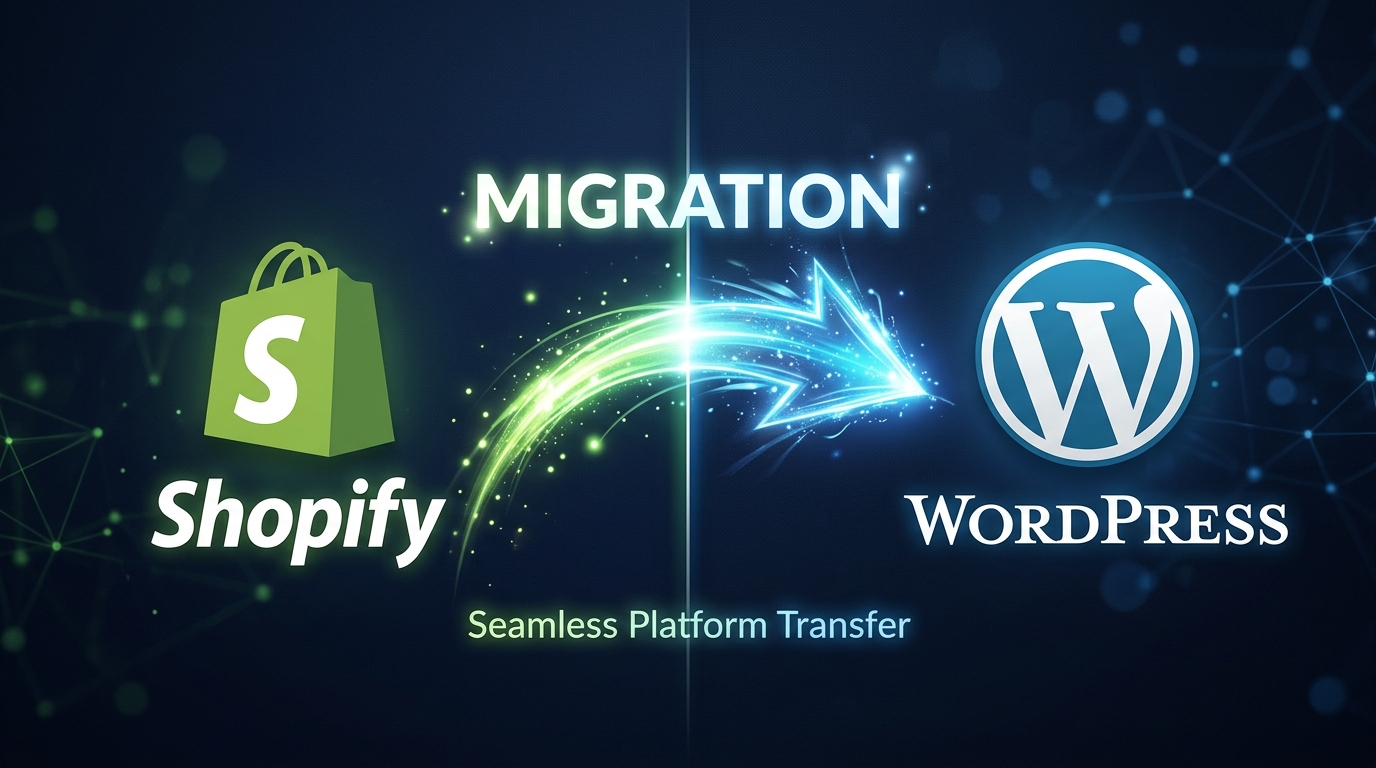
Some store owners start on Shopify and move to WooCommerce once they outgrow its limits or the running costs stop making sense. Our Shopify to WordPress migration guide explains how to move without losing data, rankings or customer records.
If you want a team to handle the move for you, see our website migration service.
Final Verdict
There is no platform that is better for everyone, only the right platform for your business. WooCommerce wins on flexibility, ownership, SEO control and, for many growing stores, long-term cost. Shopify wins on ease of use, managed infrastructure and speed to launch.
If you are still unsure, we are happy to look at your situation and give you a straight answer. Get in touch to talk it through, or check our pricing for online store builds on either platform.

2 comments