

Headless WordPress vs. Traditional WordPress: Which Architecture Is Right for Your Business?
The WordPress ecosystem has come a long way from its blogging roots. Today it powers everything from simple five-page business sites to enterprise content platforms handling millions of visitors a month. And as the web matures, a meaningful architectural debate has emerged: should your next WordPress project go headless — or stick with the proven traditional setup?
This isn’t just a developer preference discussion. It’s a strategic business decision that affects your content team’s daily workflow, your development costs, your SEO performance, and your ceiling for growth. If your developer hasn’t had this conversation with you in plain language, that’s worth noting.
How Traditional WordPress Works
In a traditional — or “coupled” — WordPress setup, the platform handles everything: content management, templating, and page delivery all in one system. WordPress generates HTML on the server and sends complete pages directly to visitors’ browsers. One codebase. One deployment. One team to maintain it.
This setup powers the majority of the 43%+ of websites on WordPress. It’s battle-tested, well-documented, and supported by a massive ecosystem of developers, plugins, and themes. For most businesses working with our WordPress development service, this is where the conversation starts — and often where it ends, for very good reasons.
What Is Headless WordPress?
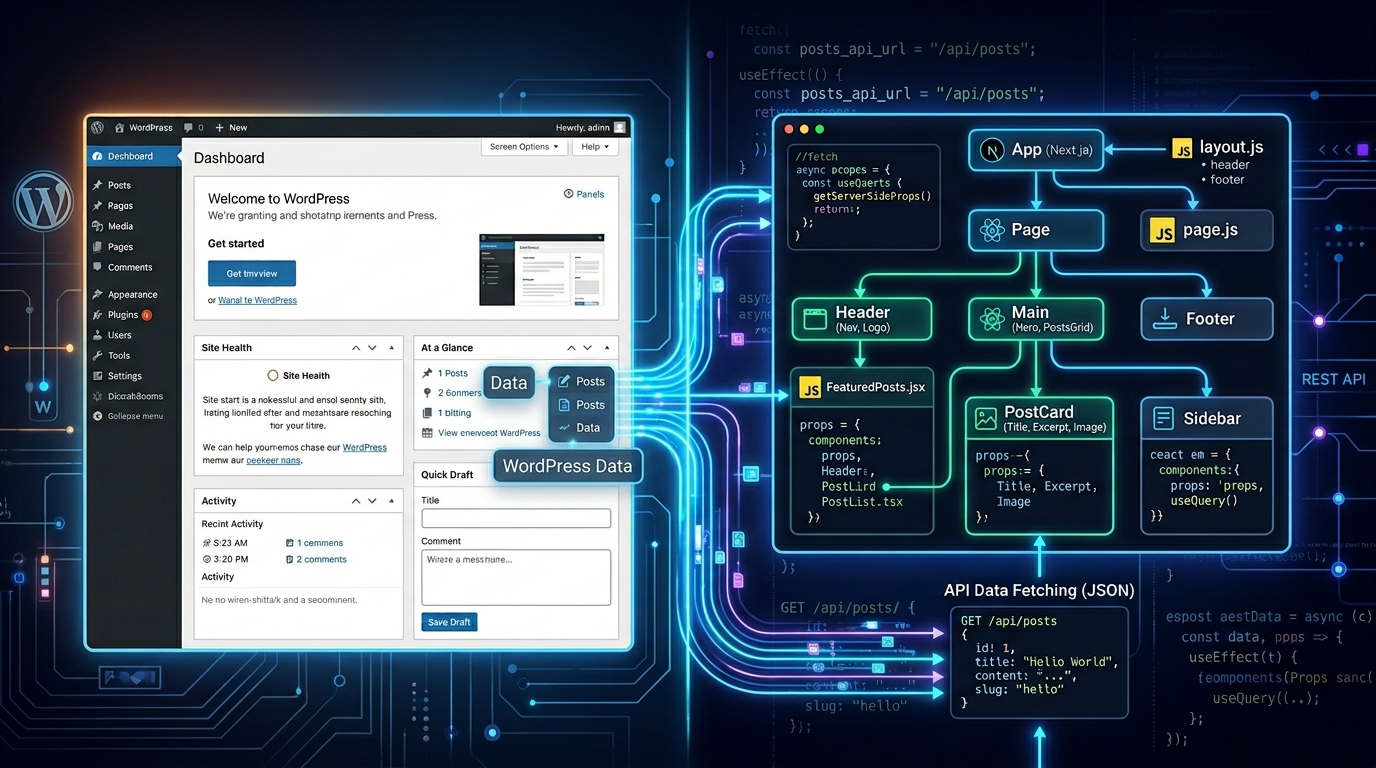
Headless WordPress separates the back end from the front end. WordPress still manages your content — editors still use the familiar admin, custom fields, and media library. But instead of WordPress rendering the final pages, it exposes content through a REST API or GraphQL endpoint. A separate frontend application — typically React, Next.js, or Vue — consumes that data and handles everything the visitor actually sees.
Kitchen and dining room: WordPress preps the ingredients, the frontend framework decides how every dish is presented to every guest.
Side-by-Side Comparison
Performance
- Traditional: Determined by hosting quality, caching setup, and theme architecture. A well-built custom site can be extremely fast — but it requires deliberate engineering.
- Headless: The frontend can be pre-rendered and served via global CDN, delivering near-instant loads regardless of origin server location. This is headless’s clearest genuine advantage.
Developer Talent and Cost
- Traditional: PHP-based with a massive talent pool. Easier to find skilled developers across all price ranges.
- Headless: Requires JavaScript framework expertise combined with WordPress knowledge. That intersection is rarer and commands higher rates.
Content Editor Experience
- Traditional: What editors see in the backend closely mirrors what visitors experience. Intuitive for non-technical teams.
- Headless: Editors work in the same WordPress admin — but can’t see how content renders on the decoupled frontend without additional preview tooling and configuration.
SEO
- Traditional: Mature SEO plugin ecosystem. Server-side rendering means Google crawls content reliably with no special configuration.
- Headless: With proper SSR or static generation, SEO performance can be excellent. But a carelessly built headless site using client-side rendering can be an SEO disaster.
Infrastructure Cost and Complexity
- Traditional: One system to host, deploy, and maintain. Lower total cost for most businesses.
- Headless: Two systems — WordPress backend plus frontend host (Vercel, Netlify) — each with their own deployment, monitoring, and potential failure points.
When Headless Makes Sense
- You need to publish identical content across multiple platforms simultaneously — web, iOS app, Android app, digital signage.
- You’re building a highly interactive application where experience must feel native-app-like.
- Your development team already works in React or Next.js and context switching would cost more than the headless overhead.
- You need unconditional edge-served performance and are prepared to invest in maintaining the infrastructure.
When Traditional Is the Right Call
- You need a fast, high-quality site without the overhead of two separate systems
- Your content team is non-technical and needs a seamless daily editing experience
- Budget and timeline are real constraints
- Your goals are lead generation, e-commerce, or content-driven SEO growth — not app-like interactions
- You want full access to the WordPress plugin ecosystem without custom API integrations for every feature
“Headless isn’t better than traditional WordPress. It’s a different tool for a different problem. The best architecture is the simplest one that genuinely solves your specific problem.”

Comments