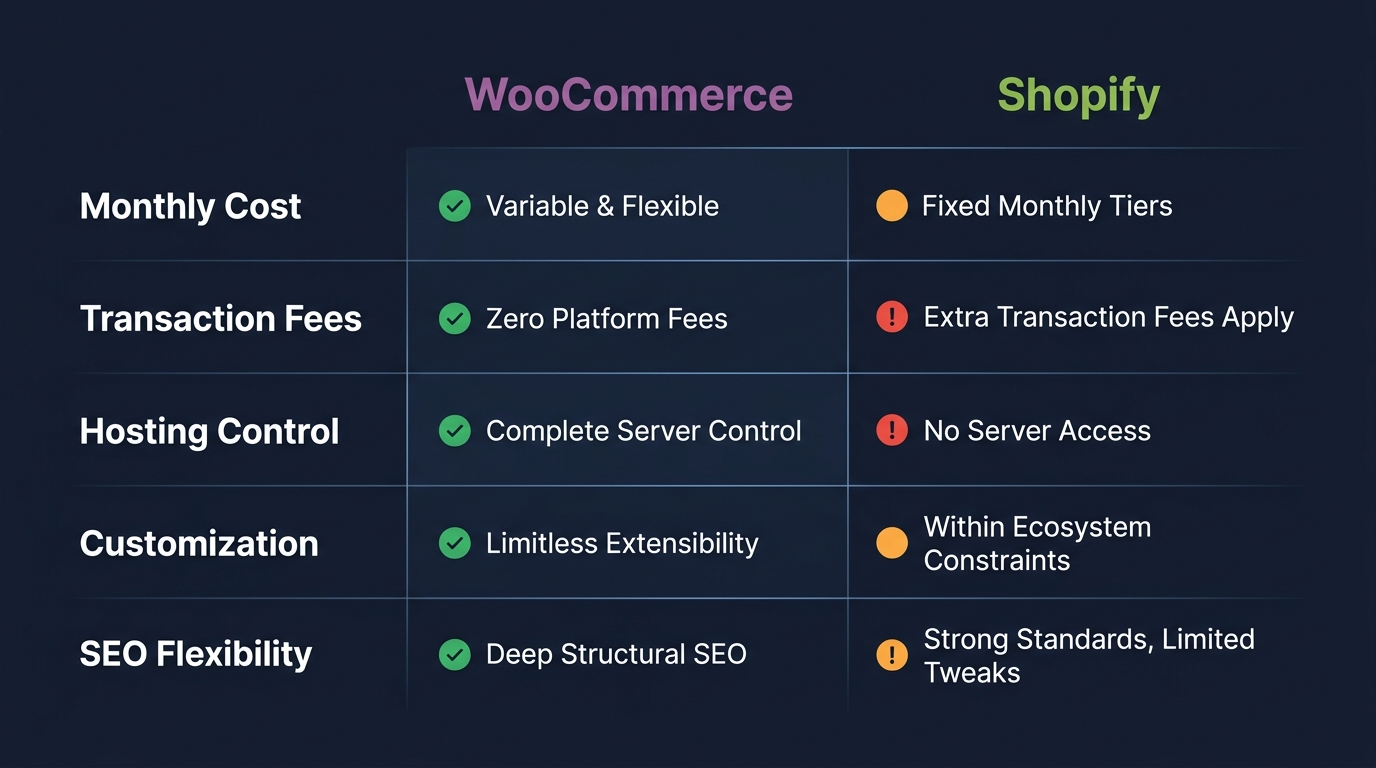
If you are building an online store in 2026, you will almost certainly end up evaluating two platforms: WooCommerce and Shopify. They are the two dominant options in the market, and both are genuinely capable of powering a successful e-commerce business. The question is which one is right for yours.
At Vyntic Studio, we build on both platforms for clients across multiple industries. We do not have a platform bias — we have a results bias. This WooCommerce vs Shopify comparison gives you a clear, honest breakdown across the factors that matter most: cost, flexibility, SEO capability, scalability, and ease of use. By the end, you will know exactly which platform aligns with your goals.
A Quick Overview of Each Platform
WooCommerce
WooCommerce is a free, open-source e-commerce plugin built for WordPress. It powers over 6 million active online stores and holds roughly 38% of the global e-commerce market. Because it runs inside WordPress, it inherits the full power and flexibility of the world’s most popular CMS — including complete ownership of your data, complete control over your code, and access to tens of thousands of plugins and integrations.
Shopify
Shopify is a fully hosted, all-in-one e-commerce platform. It handles hosting, security, updates, and infrastructure for you in exchange for a monthly subscription fee. Shopify is designed to get stores online quickly with minimal technical knowledge required. It currently powers over 4.6 million live stores worldwide and is particularly popular with direct-to-consumer brands and dropshipping operations.
Who Should Choose
Cost Comparison: What You Actually Pay
This is where the comparison gets more interesting than most people expect, because the real cost difference is not always obvious upfront.
Shopify’s Cost Structure
- Basic plan: $39/month
- Shopify plan: $105/month
- Advanced plan: $399/month
- Transaction fees: 0.5–2% on every sale unless you use Shopify Payments (not available in all countries)
- App costs: many essential features require paid third-party apps averaging $10–$50/month each
For a store doing $10,000/month in revenue on the Basic plan with a 2% transaction fee, that is $200/month in fees before apps. Add 3–4 apps and you could easily be spending $400–$600/month just to keep the platform running.
WooCommerce’s Cost Structure
- WooCommerce plugin: free
- Hosting: $20–$60/month for managed WordPress hosting (scales with your needs)
- Domain: $10–$15/year
- SSL: free via Let’s Encrypt on most hosts
- Transaction fees: 0% from WooCommerce (your payment gateway takes its standard fee: ~2.9% + 30¢ for Stripe)
- Premium extensions: pay once, not monthly, for most functionality
A well-configured WooCommerce store often costs 40–60% less annually than a comparable Shopify setup — especially for stores doing meaningful revenue where transaction fees add up quickly.
Flexibility and Customization
WooCommerce wins this category decisively. Because it is open source and runs on WordPress, you can customize literally every aspect of your store — the checkout flow, the product page layout, the cart experience, the admin interface, and the underlying database structure. If you can describe what you want, a developer can build it.
Shopify offers strong design flexibility within its Liquid templating system, but you are always working within the boundaries Shopify defines. Certain things simply cannot be changed on Shopify regardless of budget — URL structures, checkout page customization (on lower plans), and backend data access all have hard limits.
For most standard stores, Shopify’s customization is sufficient. For businesses with complex requirements — custom pricing rules, B2B portals, unique checkout logic, deep third-party integrations — WooCommerce gives you the room to build exactly what the business needs.
SEO Capability
WooCommerce, running on WordPress, gives you more SEO control than any other major e-commerce platform. You have full control over URL structures, canonical tags, schema markup, meta data, heading hierarchies, internal linking architecture, and technical SEO elements at every level of the site.
Combined with plugins like Rank Math or Yoast SEO, a WooCommerce store can be tuned for search performance in ways that are simply not possible inside Shopify’s more restrictive environment. Shopify automatically appends “/collections/” and “/products/” to URLs and does not allow these to be changed — a limitation that affects URL structure optimization and can create unnecessary redirect chains during migrations.
Shopify has improved its SEO capabilities significantly over the years, and for most businesses it is more than adequate. But for businesses where organic search is a primary growth channel, WooCommerce provides a material advantage.
Ease of Use
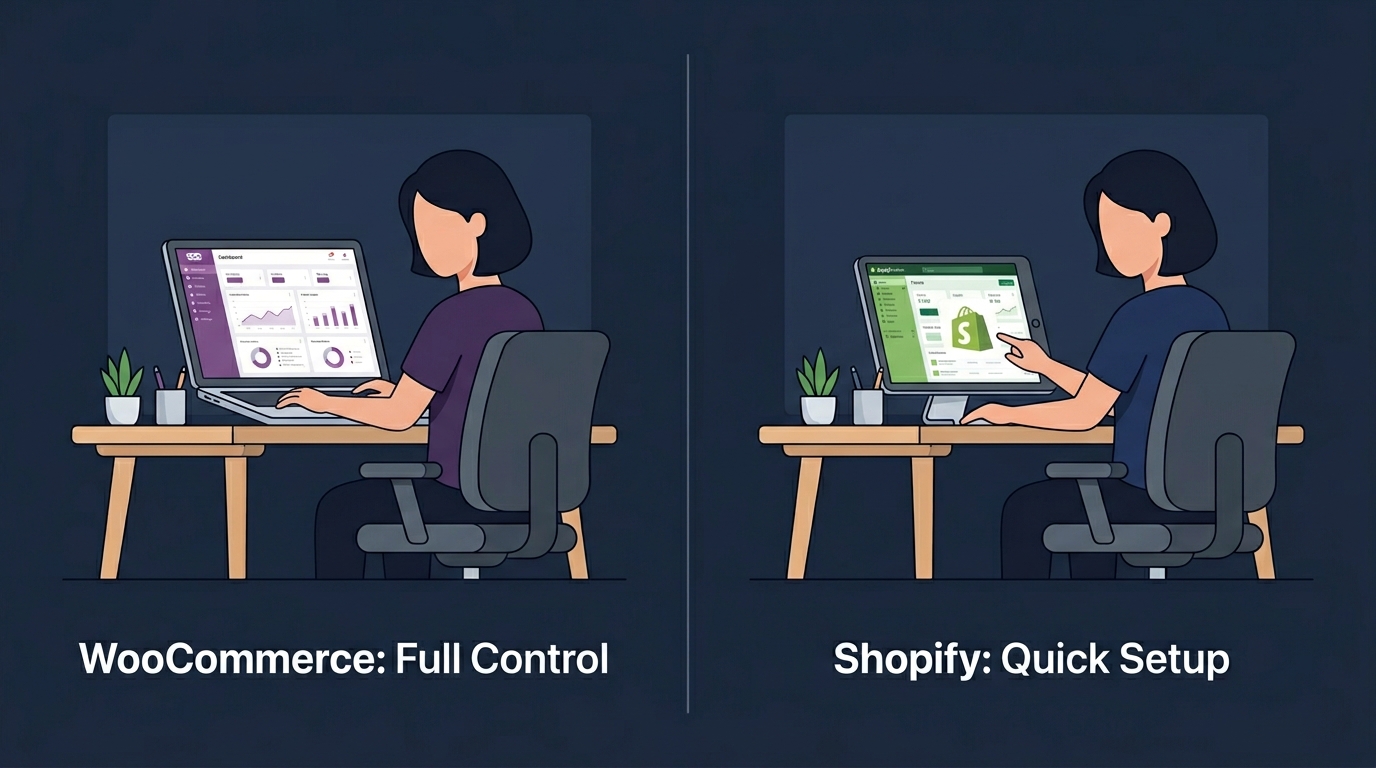
Shopify is easier to use out of the box. Its admin interface is clean and intuitive, and it guides new store owners through setup with helpful prompts and defaults. There is no hosting to configure, no WordPress updates to manage, and no technical decisions to make about infrastructure.
WooCommerce has a steeper initial learning curve. You are responsible for hosting, updates, backups, and security — either managing these yourself or delegating them to a developer or agency. For business owners who want complete control, this is a feature. For those who want to focus exclusively on their products and marketing, it can feel like an overhead.
This is one of the reasons many businesses choose to work with an agency for their WooCommerce build — getting all the advantages of the platform without carrying the technical management burden themselves. Our e-commerce development service handles every technical aspect of your store, from build to launch to ongoing maintenance.
Scalability
Both platforms scale, but differently.
Shopify’s infrastructure scales automatically — you do not need to think about server capacity as your traffic and order volume grow. This is a genuine advantage for stores that experience unpredictable spikes (think seasonal peaks or viral product moments).
WooCommerce scales with your hosting environment. With the right managed hosting infrastructure, WooCommerce handles very high traffic and order volumes effectively — but this requires intentional configuration. A WooCommerce store on inadequate shared hosting will struggle; the same store on properly configured managed infrastructure will perform excellently.
Who Should Choose WooCommerce?
WooCommerce is the stronger choice for businesses that:
- Want full ownership of their store, data, and codebase
- Already have or are building a WordPress website and want their store in the same ecosystem
- Have complex product requirements — variable pricing, subscriptions, B2B, wholesale
- Are doing significant revenue where transaction fee savings make a meaningful financial difference
- Prioritize SEO performance and want maximum control over technical optimization
- Plan to heavily customize their checkout or product experience
Who Should Choose Shopify?
Shopify is the stronger choice for businesses that:
- Want to launch quickly with minimal technical setup
- Prefer a fully managed platform with no hosting or update responsibilities
- Are operating a straightforward product catalog without complex pricing or checkout requirements
- Run a dropshipping operation where Shopify’s app ecosystem is well-suited
- Have predictable high-volume traffic and want automatic infrastructure scaling
Thinking About Switching from Shopify to WooCommerce?
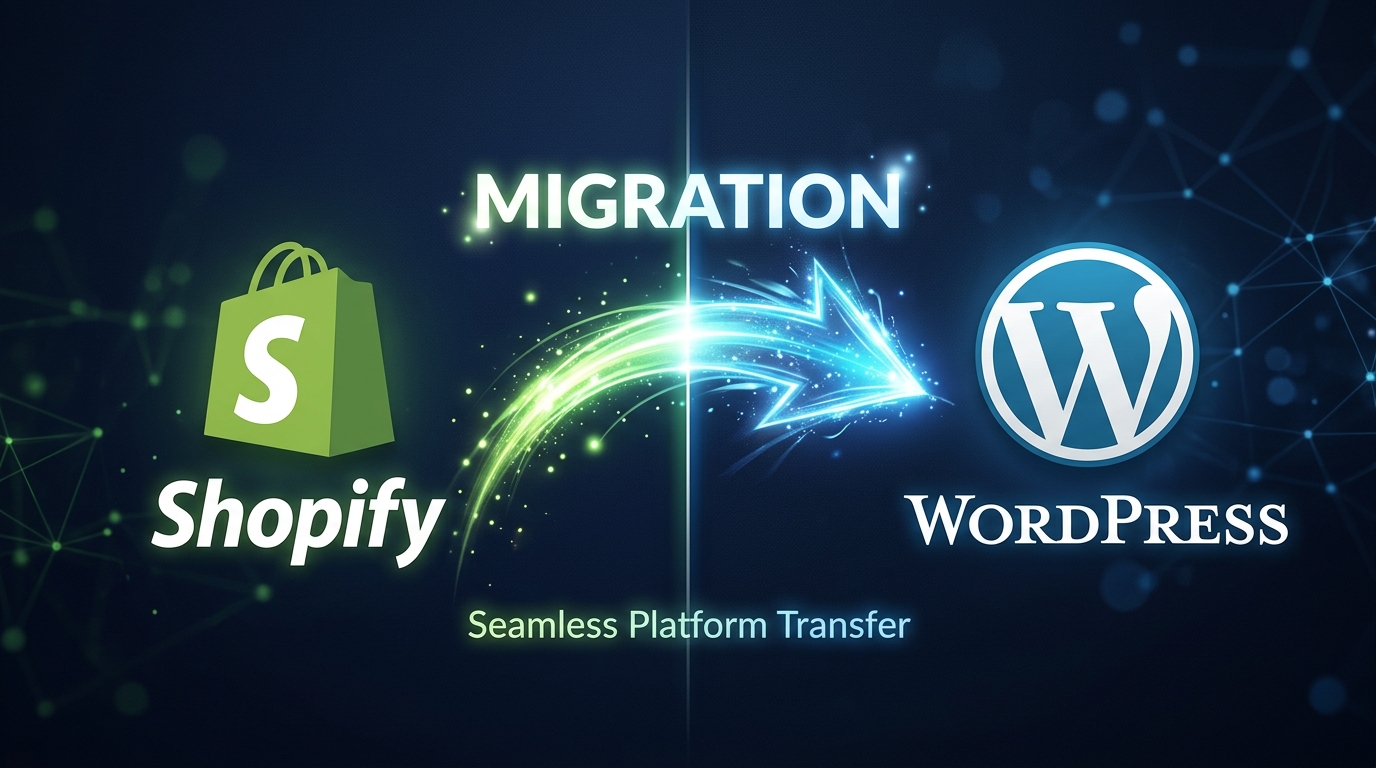
Many store owners start on Shopify and migrate to WooCommerce once their business outgrows the platform’s limitations or the cost structure stops making sense. We have managed this migration many times and written a detailed guide covering exactly how to do it without losing data, SEO rankings, or customer records.
You can also explore our migration to WordPress service if you are ready to make the move and want a team to handle it professionally.
Final Verdict
There is no universally “better” platform — only the right platform for your specific business requirements. WooCommerce wins on flexibility, ownership, SEO control, and long-term cost. Shopify wins on ease of use, managed infrastructure, and fast time-to-launch.
If you are not sure which direction to go, our team is happy to discuss your specific situation and give you a straight answer. Get in touch here — we do not have a platform to sell you, just the right recommendation for your business.
Ready to build a high-performance store on either platform? Start a project with Vyntic Studio and let’s scope it out together.